Skip to content
Corporate Responsibility
Resource Center

Corporate Responsibility Resource Center

Learn more about our legacy and strategy for a sustainable future.

Updated Emissions Reduction Targets

Our updated emissions targets represent an important step forward in our decarbonization journey.

A Legacy of Product Innovation

Our innovative products are designed with the needs of consumers and the planet in mind.

Managing Emissions in Our Operations

Guided by our emissions targets, we are making strong progress toward decarbonizing our operations.

Our Legacy of Responsibility

For more than a century, Whirlpool Corporation has been dedicated to improving life at home for our consumers, in our operations and in our communities. Through a corporate responsibility strategy deeply aligned with our business and values, we invest in a better future for all through the way we do business and the products we build today.

Download Our
Responsibility Timeline

“We cannot separate our business from the communities in which we operate, and hope to grow and prosper.”

— Former CEO Elisha “Bud” Gray II in his letter to shareholders in 1969, which led to the establishment of our Internal Office of Environment in 1970.

  1. 1969 CEO Elisha “Bud” Gray II issues letter to shareholders on the importance of sustainability
  2. 1970 Established the Office of Environment, the first in the home appliance industry
  3. 1980s Product innovation to reduce energy and water consumption
  4. 1990s Helped start the ENERGY STAR® program
  5. 1993 Published formal Code of Ethics to guide our business and operating principles
  6. 1995 Created our first formal employee resource group: Whirlpool Women's Network
  7. 1998 Launched the industry’s first energy- and water-efficient top-load washer
  8. 1999 Established a relationship with Habitat for Humanity®
  9. 2002 Launched Instituto Consulado da Mulher in Brazil
  10. 2003 Became the world’s first appliance manufacturer to set a global greenhouse gas reduction target
  11. 2008 Published first Sustainability Report
  12. 2012 Established a Zero Waste to Landfill by 2022 goal for all of our manufacturing sites
  13. 2020 Received approval from the Science Based Targets initiative (SBTi) for emissions reductions targets
  14. 2021 Announced global sustainability commitment with emissions reduction targets in our operations and products in use
  15. 2022 Met our Zero Waste to Landfill goal
  16. 2022 Established two Virtual Power Purchase Agreements covering 100% of U.S. based emissions from our plants
  17. 2024 Matched 100% of electricity needs in U.S. plants with on-site and off-site renewable energy projects
  18. 2024 Celebrated 25 years of collaboration with Habitat for Humanity International
  19. 2025 Updated near-term emissions reduction targets and established a new long-term target, validated by the SBTi

Our Guiding Principles

Our Vision

Be the best kitchen and laundry company, in constant pursuit of improving life at home.

Our Mission

Earn trust and create demand.

Our Values

Integrity
Respect
Inclusion &
Diversity
One
Whirlpool
Spirit of
Winning

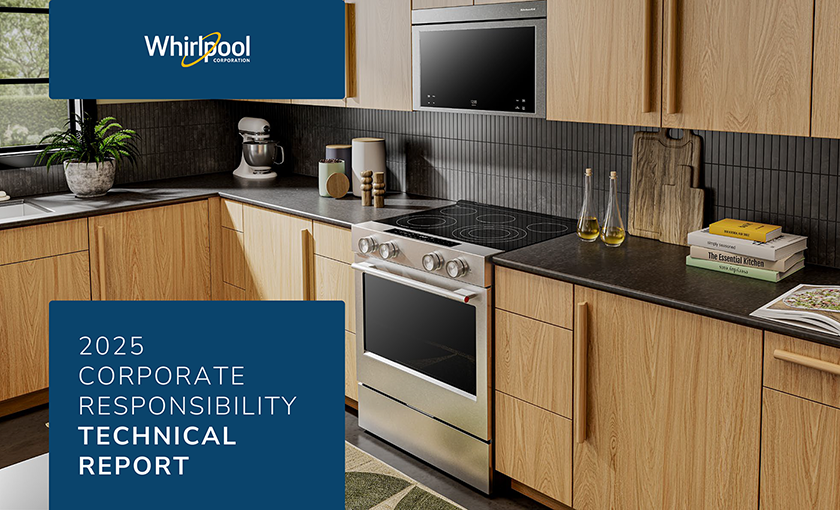
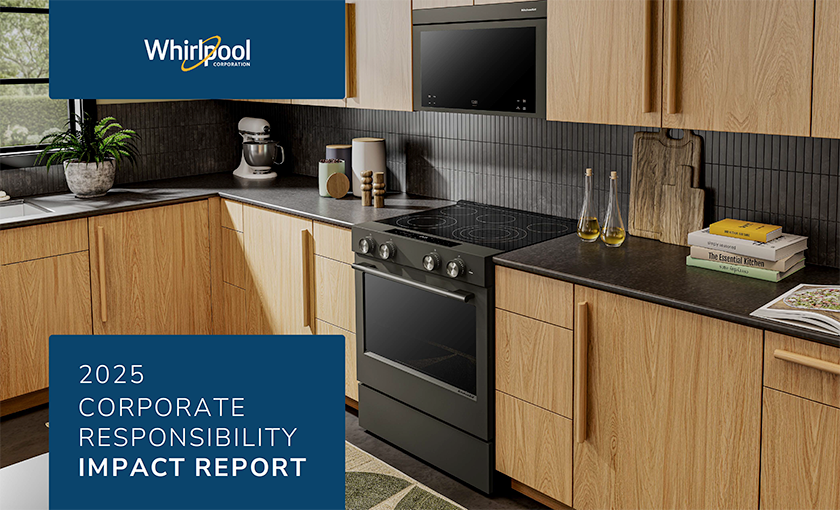
To learn more about the progress we made in 2025, please see our Impact Report and Technical Report.
Take me to

The Private Securities Litigation Reform Act of 1995 provides a safe harbor for forward-looking statements made by us or on our behalf. Certain statements contained in this and other written and oral statements made from time to time by us or on our behalf do not relate strictly to historical or current facts and may contain forward-looking statements that reflect our current views with respect to future events and financial performance. As such, they are considered “forwardlooking statements” that provide current expectations or forecasts of future events. Such statements can be identified by the use of terminology such as “may,” “could,” “will,” “should,” “possible,” “plan,” “predict,” “forecast,” “potential,” “anticipate,” “estimate,” “expect,” “project,” “intend,” “commit,” “believe,” “may impact,” “on track,” “guarantee,” “seek,” “would,” “committed,” “undertake,” “target” and the negative of these words and words and terms of similar substance. Our forwardlooking statements generally relate to our strategic and transactional objectives, operational planning and implementation, financial projections, goals, and assumptions, external and macroeconomic conditions, and legal, regulatory and sustainability matters. These forward-looking statements should be considered with the understanding that such statements involve a variety of risks and uncertainties, known and unknown, and may be affected by inaccurate assumptions. Consequently, no forward-looking statement can be guaranteed, and actual results may vary materially.

This document contains forward-looking statements about Whirlpool Corporation and its consolidated subsidiaries (“Whirlpool”) that speak only as of this date. Whirlpool disclaims any obligation to update these statements. Forward-looking statements in this document may include, but are not limited to, statements regarding future financial results, environmental, social, and governance efforts, longterm sustainability and Net Zero goals, including emissions reduction targets, risk management and resilience, product innovation, durability and resource efficiency, product safety and quality, second life and end-of-life initiatives, responsible sourcing and supply chain management, sustainable operations and investments in renewable energy, and efforts related to workplace health and safety, employee engagement, and community impact. Many risks, contingencies and uncertainties could cause actual results to differ materially from Whirlpool’s forward-looking statements. Among these factors are: (1) intense competition in the home appliance industry, and the impact of the changing retail environment, including direct-toconsumer sales; (2) Whirlpool’s ability to maintain or increase sales to significant trade customers and builders; (3) Whirlpool’s ability to maintain its reputation and brand image; (4) Whirlpool’s ability to achieve its business objectives and successfully manage its strategic portfolio transformation and outsourced business unit service model; (5) Whirlpool’s ability to understand consumer preferences and successfully develop new products; (6) Whirlpool’s ability to obtain and protect intellectual property rights; (7) acquisition, divestiture, and investment-related risks, including risks associated with our past transactions; (8) the ability of suppliers of critical parts, components and manufacturing equipment to deliver sufficient quantities to Whirlpool in a timely and cost-effective manner; (9) risks related to Whirlpool’s international operations; (10) Whirlpool’s ability to respond to unanticipated social, political and/or economic events, including epidemics/ pandemics; (11) information technology system and cloud failures, data security breaches, data privacy compliance, network disruptions, and cybersecurity attacks; (12) product liability and product recall costs; (13) Whirlpool’s ability to attract, develop and retain executives and other qualified employees; (14) the impact of labor relations; (15) fluctuations in the cost of key materials (including steel, resins, and base metals) and components and the ability of Whirlpool to offset cost increases; (16) Whirlpool’s ability to manage foreign currency fluctuations; (17) impacts from goodwill, intangible asset and/or inventory impairment charges; (18) health care cost trends, regulatory changes and variations between results and estimates that could increase future funding obligations for pension and postretirement benefit plans; (19) impacts from credit rating agency downgrades; (20) litigation, tax, and legal compliance risk and costs; (21) the effects and costs of governmental investigations or related actions by third parties; (22) changes in the legal and regulatory environment including environmental, health and safety regulations, data privacy, taxes and generative AI; (23) the impacts of changes in foreign trade policies, including tariffs; (24) Whirlpool’s ability to respond to the impact of climate change and climate change or other environmental regulation; and (25) the uncertain global economy and changes in economic conditions.

Other Important Notes & Disclaimers

Various of the disclosures in this report are informed by the expectations of various stakeholders and/or third-party frameworks. Such information may not necessarily be material for purposes of our filings under U.S. federal securities laws, even if we use “material” or similar language in discussing such matters. Particularly in the ESG context, there are various approaches to materiality that differ from, and in many cases are more expansive than, the definition under U.S. federal securities laws. Furthermore, much of this information is subject to methodologies and data that continue to evolve. Over time, our approach to such matters has also evolved and is expected to continue evolving, and we cannot guarantee that our approach will align with the expectations or preferences of any particular stakeholder. For example, the processes for measuring and accounting for ESG metrics can involve substantial discretion, include assumptions or other methodological considerations that involve inherent uncertainty and may change due to evolving understanding or perception of certain matters by us or society at large. This can make it difficult to anticipate the ultimate outcomes of certain decisions in advance, as well as complicate the comparison of information presented at different times or under different circumstances or standards. Moreover, while we aim to align various disclosures set forth or referred to in this report with the recommendations of various third-party frameworks, such as the Sustainability Accounting Standards Board and the Task Force on Climate-related Financial Disclosures, we cannot guarantee strict adherence to these frameworks’ recommendations. Our disclosures, as well as relevant internal controls, also may change due to revisions in framework requirements, availability or quality of information, changes in our business or applicable government policies, or other factors, some of which may be beyond our control.