
Occupational Health & Safety

Every Whirlpool Corporation employee shares responsibility for their own safety and the safety of colleagues, contractors and visitors. Through the We Care Environment, Health, Safety and Sustainability (EHSS) Management System, we have established a process to identify and evaluate risks, in order to implement effective and sustainable controls to protect our people and the environment. As part of our corporate governance and risk management process, we conduct annual site self-assessments against regulatory and Whirlpool requirements, as well as a triennial corporate assessment to validate results and drive continual improvement.
Safeguarding Employees
Employees in our manufacturing, warehouse and field service locations periodically encounter safety hazards. We minimize risk through carefully designed controls, multiple layers of defense and our skilled, authorized employees. Whirlpool Corporation’s Attitudes for Life outline 10 “life-critical” topics that define essential precautions and expected behaviors for preventing serious injuries to employees and contractors involved in high-risk activities.
All employees are trained in our "Attitudes for Life" and equipped to intervene when colleagues face potentially dangerous situations. Safety events (unsafe acts, conditions and near misses) are reported by employees at all levels, and we encourage employees to escalate safety concerns when they occur. Employees can report concerns confidentially through the Whirlpool Corporation Integrity Line, if preferred.
Sharing Responsibility for Our Attitudes for Life
We maintain and display safety information and reinforce procedures for keeping employees safe in all types of hazardous activities they may encounter, including:
-
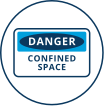 Confined Space
Entry -
 Hazardous
Substances -
 Driver
Safety -
 Electrical
Safety -
 Crane, Hoist and
Lifting Equipment -
 Powered
Industrial Vehicles -
 Machine
Safety -
 Hazardous
Energy Control -
 Work at
Height -
 Hot
Hot
Work
Safety Focus Site Program
To provide targeted support where needed, we launched the Safety Focus Site program in 2023. Through this program, we aim to identify sites falling short of expectations and increase leadership awareness of opportunities for improvement, which can help drive consistent focus on activities that improve safety performance. Site leaders report their progress during regular meetings that enable feedback and accountability. Since its inception, the program has resulted in a notable decrease in employee injuries.
Contractor Safety
To ensure contractor safety, Whirlpool expects the same proactive and preventive approach from contractors as we expect from our own employees. Contractors performing high-risk activities must be pre-qualified before arriving at the site by demonstrating compliance with environmental, health and safety (EHS) requirements, along with a history of positive performance. Our Attitudes for Life expectations also apply to high-risk contractors, and non-compliance can result in disqualification from working at any Whirlpool location.
Safety Performance Evaluation
We regularly track industry-standard health and safety key performance indicators, including total recordable incident rate, lost time incident rate and serious incidents. Additionally, we track many leading key activity indicators, such as concern report closure rate, compliance calendar task closure rate and major action closure rates, all of which are indicators of our success in addressing employee EHS-related concerns.
We expect and continue to reduce incidents year over year. We have consistently and significantly outperformed the average incident rates of our industry, based on data from the U.S. Bureau of Labor Statistics North American Industrial Classification System for the Major Household Appliance Manufacturing Industry.
Whirlpool Incident Rates Versus Industry: Five-Year Trend
Recordable Incident Rate1
- Whirlpool
- Industry Average 2024
Lost Time Incident Rate2
- Whirlpool
- Industry Average 2024
80% better than the industry average
75% better than the industry average
- Recordable Incident rate is calculated as number of recordable injury and illness cases multiplied by 200,000 (100 full-time-equivalent employees/non-employees working 40 hours per week for 50 weeks) then divided by the number of hours worked for the reporting period.
- Lost Time Incident Rate is calculated as number of the days away from work cases multiplied by 200,000 (100 full-time-equivalent employees/non-employees working 40 hours per week for 50 weeks) then divided by the number of hours worked for the reporting period.