
Energy & Emissions

Energy and emissions reductions are fundamental to a World Class Manufacturing (WCM) operation and the centerpiece of our environmental footprint management. In 2003, Whirlpool Corporation was the first appliance manufacturer to set an emissions reduction target. We have continued to make significant progress toward reducing our emissions each year. Our commitment covers all direct (Scope 1) and indirect (Scope 2) emissions throughout our plants and operations.
Our Emissions Reduction Journey

2003
Became the world’s first appliance manufacturer to set a global greenhouse gas (GHG) reduction target
2020
Received approval from the Science Based Targets initiative (SBTi) for emissions reductions targets
2025
Refreshed our near-term targets, set new long-term net-zero targets and obtained approval by the SBTi

Reduce Scope 1 and 2 emissions by 65% by 2030,
compared to 2021 levels.
For more information on our targets, please see our Emissions Reduction Targets page.
Decarbonization Plan
Our innovative manufacturing processes require a lot of energy. To work toward decarbonization, we have created a four-point plan that follows a systematic approach, starting with emissions reduction through energy and consumption management, followed by the expansion of renewables and electrification. To neutralize residual emissions, we plan to invest in a portfolio of high-quality carbon credits.
Our Four-Point Plan to Reduce GHG Emissions

Reduce Energy Usage
Reduce energy consumption through both WCM efficiency projects and facility retrofits. Projects include LED lighting, compressed air use reductions, and boiler and HVAC optimization.

Expand Renewables
Implement 100% renewable energy for electricity consumption.

Electrify/Substitute
Electrify and replace fossil fuels use with other energy sources — such as hydrogen, biogas or other — everywhere possible to reduce Scope 1 emissions.

Neutralize Residual Emissions
Invest in a portfolio of high-quality carbon credits to neutralize residual emissions.
Progress Over Time
Our efforts to reduce emissions across our operations have led to significant progress toward our goals. For details on our progress over time, please see our 2025 Impact Report and Technical Report.
Operational Innovations and Renewables
At our site in Cleveland, Tennessee, we are expanding the use of hydrogen to fuel material handling equipment, such as forklifts and tuggers.
Many of our sites have invested in projects that use electricity to heat water in various metal cleaning applications, thereby replacing fossil fuel combustion. We are also exploring electric options for paint curing and other process heating applications.
We have invested in electric heating systems to replace natural gas-fired systems at our manufacturing facility in Clyde, Ohio, and our Regional Distribution Center in St. Louis, Missouri.
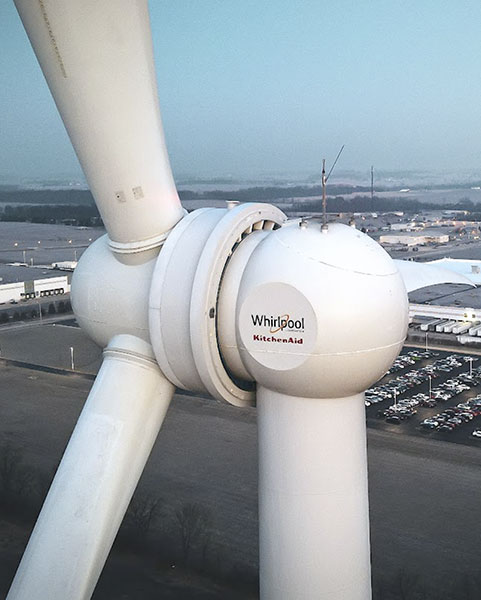
Renewables: Second only to the reduction of energy use overall, replacing fossil fuel-powered electric energy with renewables is a priority for Whirlpool Corporation. We have invested heavily in the development of on-site and off-site renewables — (wind and solar). We currently have operational installations at several facilities, as well as two off-site wind farm virtual power purchase agreements. These investments are further supplemented by market-based renewable energy attribute purchases.
-

United States
Renewable installations at four facilities
Ottawa, Ohio
Refrigeration manufacturing facility with on-site wind power
Greenville, Ohio
Small appliance manufacturing facility with on-site wind power
Findlay, Ohio
Dishwasher manufacturing facility with on-site wind power
Marion, Ohio
Washing machine manufacturing facility with on-site wind power
Beyond what we generate on site, we match a substantial portion of our U.S. operational energy consumption using our major wind projects in Texas: Engie Limestone and Clearway Mesquite Sky.
-

Brazil
Small solar farm at our Joinville location, along with renewable energy credits (RECs) that match electricity consumption in manufacturing operations and regional headquarters
-

Mexico
Use of RECs that match more than 50% of electricity consumption across sites